The Cabin Game: How to Play and Win
You win a game of The Cabin Game by staying alive until midnight and then leaving through the correct room. Which room that is comes down to three clues, and the aim is to identify them before midnight so that you know where to go when the escape begins. This page is the rulebook for a first game: the lobby, the table, how a turn works, what the card types do, how the clue system works, and what happens at midnight. Individual Event objectives are not listed here.
The short version. Everyone sits at the round table. On your turn you take one card, either the new one in the Draw Slot or a Clue Card off the Graveyard, then you play one card out of your hand. Room Cards build the cabin you walk around in. Clue Cards put a clue into play that you then get up and search for. Progress Cards push the group’s shared piece around the clock toward midnight and away from the Visitor, who is following it. Mark every clue you identify in the manual, work out which room those clues point at, and head for it once midnight is reached.
The Cabin Game is in Early Access at the time of writing, so cards, timings and menus can all change with a patch.
The Garage Lobby
Every game begins in the Garage Lobby, whether you are playing solo or with other players. A few optional settings sit on the table in the middle, and there are side areas to interact with here before starting the game.
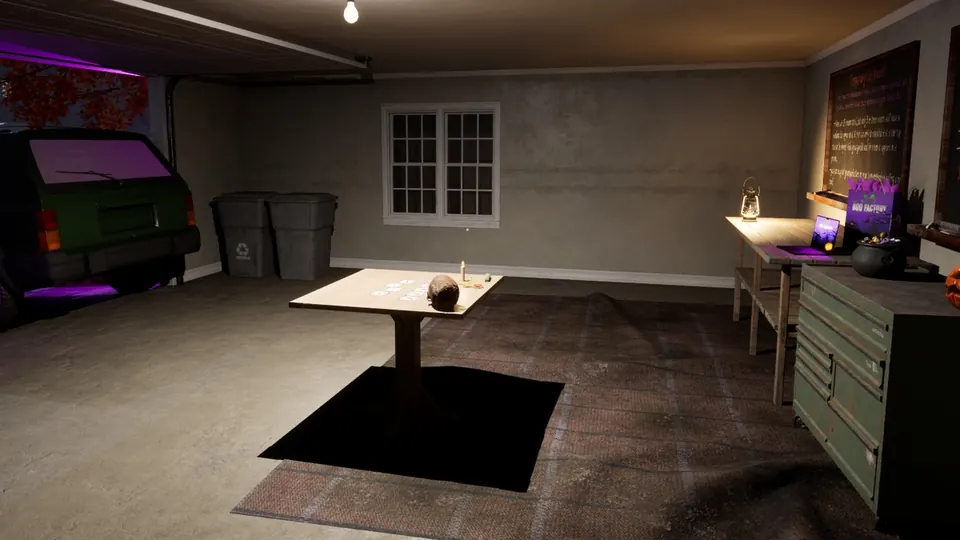
The table in the middle of the garage is what you use to open the lobby settings. One of them is the Introduction, which plays an explanation of the game once everyone is seated at the table in the cabin. Turn it off if you have heard it.
Player Customization and the Boo Factory
The door in the garage leads to the Player Customization area, where you change your character and put on cosmetic effects you have already unlocked.
Playing games earns Goodies, and Goodies are the currency at the Boo Factory. Buying the Whoopie or the Poppers puts them in your Goodie Bag. Click an item in the bag to use it. None of it is required for the main game.
Starting the game
Interact with the car once everybody is ready. With all the players inside it, the game starts and you are taken to the cabin.
The game table
Almost everything you do happens at the round table inside the cabin. Each part of the table does one job, and at first it is difficult to tell which does what.
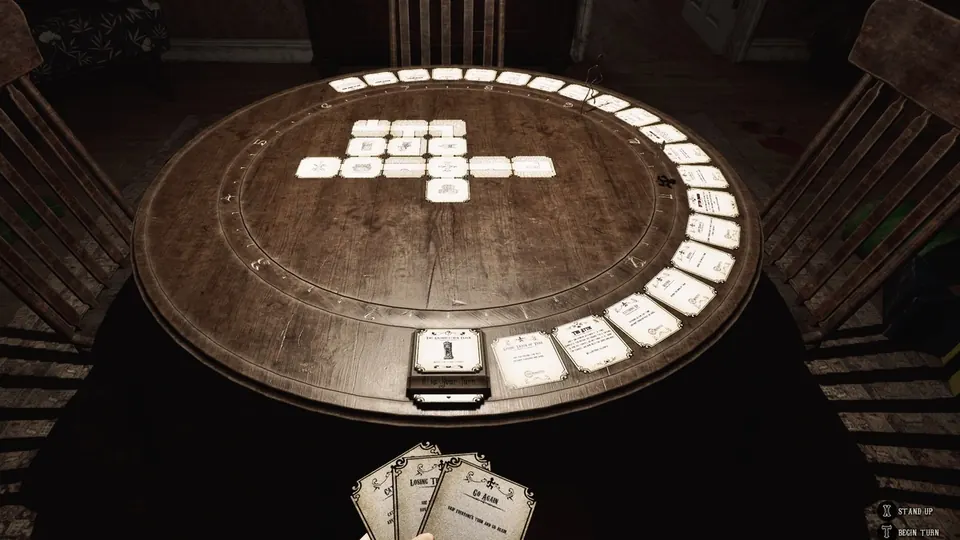
| Part of the table | What it is for |
|---|---|
| Centre | Where Room Cards are placed. The layout there grows to match the cabin you are walking around. |
| Clock track | The numbered ring around the cabin layout, which pieces travel around. |
| Draw Slot | The front of the card holder. A new card appears in it at the start of your turn. |
| Graveyard | The top of that same card holder. Clue Cards are placed on it and stay in play there. |
| Outer ring | The part of the table that turns between turns, bringing the card holder round to the next player. Cards that have already been played stay visible on it. |
There is no discard pile anywhere on the table. A card that gets removed from play by some other effect simply disappears.
The whole group shares one piece on the clock track, even in multiplayer, and everybody moves that same piece. The table rotates in a solo game too, so the holder comes back round to you each time.
Controls
The game lists the controls you can use at the table in the lower right corner of the screen.
| Key | What it does |
|---|---|
| T | Starts your turn |
| X | Stands up from the table |
| M | Opens the manual, including the Discovered Clues page |
| B | Opens your Goodie Bag, in the cabin or the garage |
| R | Rotates a Room Card you are placing |
| Scroll wheel | Zooms the cabin layout in and out |
| Left click | Inspects a card, or places a Room Card |
| Right click | Puts a card you are inspecting back into your hand |
The Cellar and your opening hand
The first Room Card of every game is The Cellar.
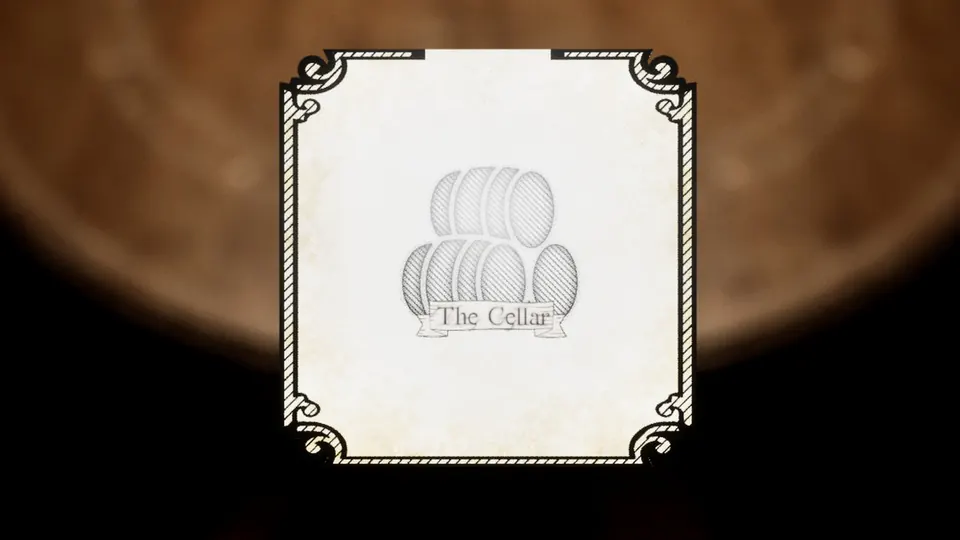
The Cellar has one doorway and nothing else, so it is a dead end. Nothing can be built off it later.
Once the Cellar is down, every player is dealt three cards. That hand of three is what you play from on your turns.
Taking a turn
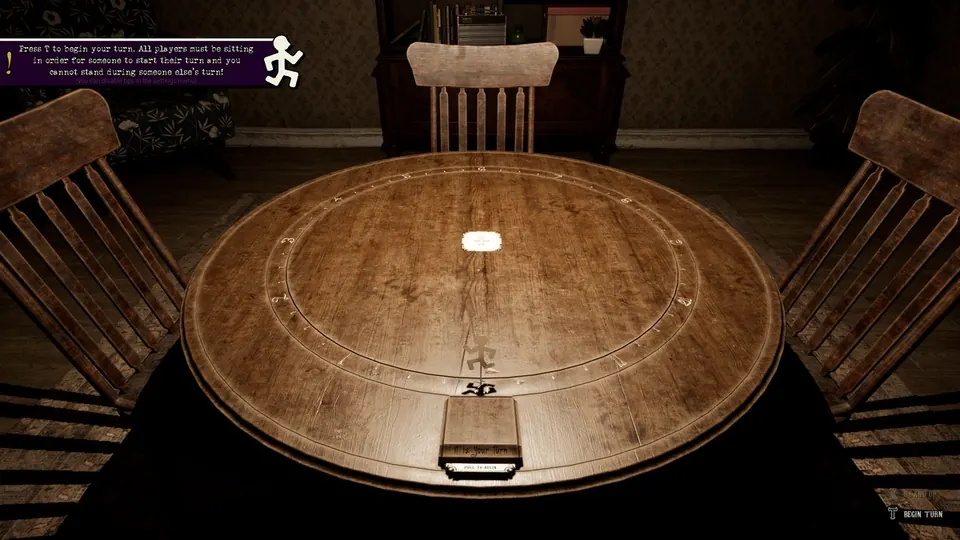
Everybody has to be sitting down before a turn can start. If one player is standing, the active player cannot start theirs. You also cannot stand up during somebody else’s turn. So your own turn is the time to be up. Stand at any other point and the next turn cannot start until you sit down.
Press T to begin your turn once the card holder has rotated to face you.
Take one card
At the start of the turn you take exactly one card, and there are two places it can come from.
- The new card waiting in the Draw Slot.
- A Clue Card that is already sitting in the Graveyard.
You do not get both, so this is the first real decision of the turn.
Looking through the Graveyard
Looking through the Graveyard commits you to nothing.
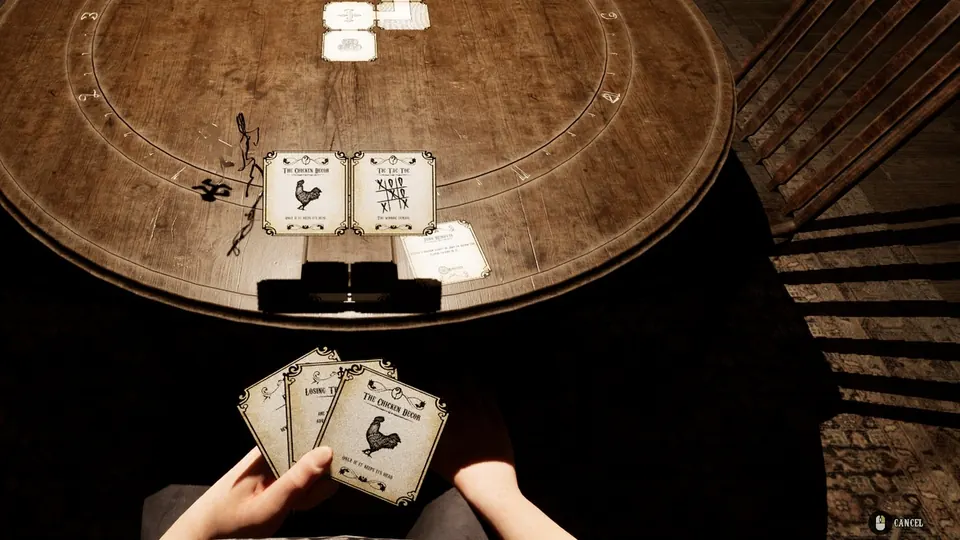
Click the Graveyard to see what is in it, then click a single Clue Card for a closer look. Accept takes that card into your hand, and Cancel puts you back to the selection. You can also back out of the Graveyard entirely and take the new card instead.
Play a card from your hand
Once you have taken a card you can look through your hand. Hovering shows you the cards, and you can bring one up for a closer look before you commit to it. When you have decided, select the card and follow whatever that card type asks of you.
Card types
These are the card types you will meet in a normal game.
| Card type | What it does |
|---|---|
| Room Card | Adds another room to the cabin. |
| Progress Card | Moves the group’s shared piece around the clock toward midnight. |
| Clue Card | Puts a clue into play for you to test inside the cabin. |
| Event Card | Starts a survival Event as soon as you accept it, rather than being played from your hand. |
Building the cabin
Placing Room Cards
Room Cards go in the centre of the game table. A Place Card prompt appears once the room lines up correctly with a doorway that is still free.
Choose your Room Card carefully
Once you select a Room Card from your hand you are committed to it. You can rotate it and move it around while you hunt for a valid spot, but you cannot cancel the play and go back for a different room.
You also cannot study the full cabin layout while you are choosing, because your view of the table is limited at that point. If you think you might add a room this turn, look the layout over before you start the turn, so you already have a spot in mind.
Why the layout matters
There is no single correct way to build the cabin, but the shape of it changes how the rest of the game feels. Rooms and hallways decide:
- where you are able to explore;
- how quickly you can get from one part of the cabin to another;
- how easy it is to hide or escape during certain Events.
Long dead ends make moving around harder. A layout with several connected routes gives you more options. The cabin does not have to be perfect. Thinking about how the rooms join up still beats dropping them wherever they fit.
Clues and the Graveyard
The clue system is how you work out which room will be the correct exit.
The active clue
Only the top Clue Card in the Graveyard counts as the active clue.
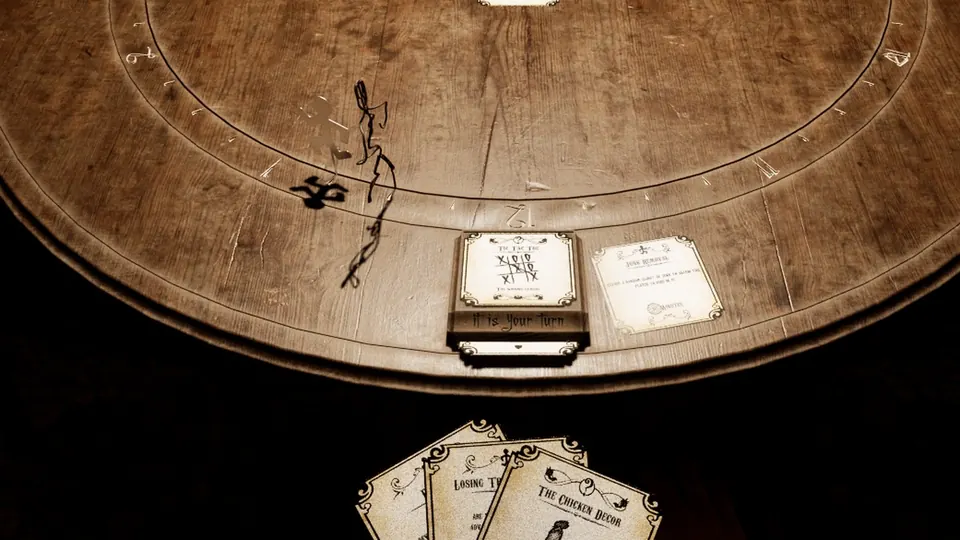
That is the one the game is currently checking for inside the cabin. Any Clue Cards stacked underneath it do nothing until they reach the top.
How to check a clue
A Clue Card sitting in the Graveyard confirms nothing by itself. You have to stand up, leave the table and search the cabin for the evidence yourself.
The clue can appear in any room that has already been added. Which room it lands in does not matter at all. You are identifying the type of clue. If the game tries to reveal a clue in a room nobody has built yet, it stays out of sight until that room exists.
Taking clues back from the Graveyard
If the card you take out of the Graveyard is the top one, the card underneath becomes the new top card and the next active clue, unless somebody covers it again. The order of the stack can matter because of that.
Graveyard Wipe
Some cards affect the Graveyard. A Graveyard Wipe removes every Clue Card sitting on it, and they are gone for good. That is the argument for pulling an important Clue Card back into your hand instead of leaving the whole stack in the Graveyard.
Revealed and Discovered
- Revealed: the clue has physically shown up somewhere in the cabin.
- Discovered: you have identified which clue it is and marked it in the manual.
Clue types
These are the clue types that can turn up inside the cabin, and what each one looks like when it does.
| Clue | What appears in the cabin |
|---|---|
| The Grandfather Clock | A grandfather clock somewhere in the cabin, along with a distinct clock strike you can hear. |
| The Past Player | Usually writing on a wall. It can also be a body part or skeletal remains. |
| Corrupt Painting | A portrait that has changed into something more ominous. |
| Paranormal Alteration | Furniture, fixtures or wallpaper in a room, changed. The change is usually an obvious one. |
| Chicken Decor | A chicken symbol on a wall. |
| Winning X Symbol | From the Tic Tac Toe Clue Card. X and O symbols appear across five rooms. |
| Winning O Symbol | The other result from that same Tic Tac Toe Clue Card. |
Corrupt Painting
A Corrupt Painting is meant to be noticeable. Take in how the paintings around the cabin normally look, because the changed one will not fit the theme of the rest.
Chicken Decor
The chicken symbol can be the real Chicken Decor clue, and it can also be a fake. A fake chicken loses its head, but only once the third and final clue has been revealed. That is late in the game, so treat Chicken Decor as unconfirmed rather than banking it as one of your three too early.
Tic Tac Toe: Winning X or Winning O
This clue behaves differently from the others. Large red X and O symbols appear around the cabin one at a time, spread across five different rooms. Once all five are up, count them.
- Three X and two O: the clue is Winning X Symbol.
- Three O and two X: the clue is Winning O Symbol.
Working out the exit room
Every exit room matches one particular combination of three clues, so each clue you rule in or out cuts the list of possible rooms down.
Press M and open the Discovered Clues page. Recording your deductions there is the point of every clue you find.
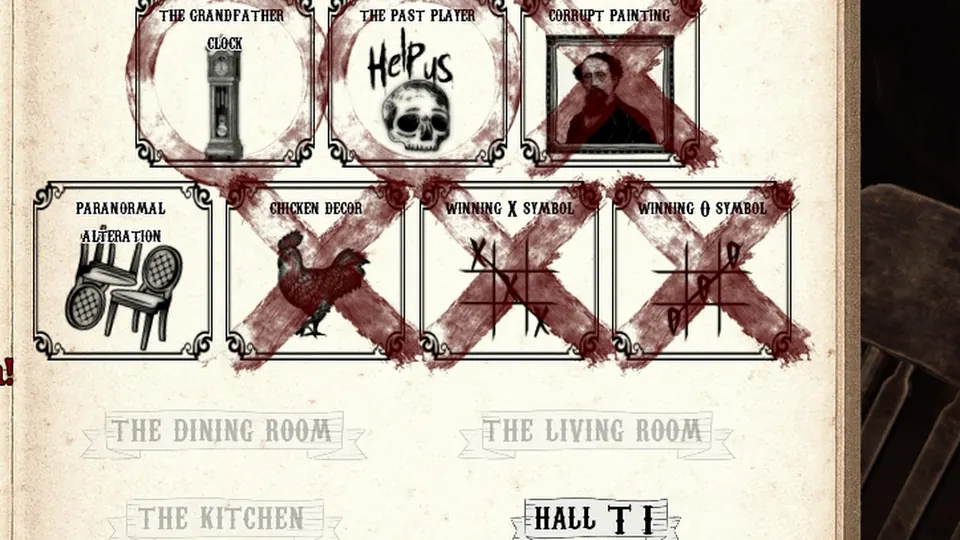
The page carries two marks. A clue type you have identified gets a red ring around it, and one you have ruled out gets a red cross through it. Clue types you have not settled on stay unmarked.
The room names underneath grey out as they stop matching your marks, so the rooms still printed in black are the ones you could still be escaping through.
Progress Cards and the clock
Progress Cards are how the group moves its shared piece around the clock toward midnight. The amount of time a card adds is printed on it, most commonly 30 minutes or 60 minutes.
An ordinary turn does not move the clock on its own. Time moves forward when:
- a Progress Card is played;
- a card effect or a penalty specifically adds time;
- a player is eliminated during an Event, which is covered further down.
Progress Cards are not always plain movement. Many have an extra effect written on them, and it can help you, hurt you, or set off something else entirely. Read the description as well as the number before you commit to one.
The Visitor
The Visitor is the game’s main threat. He sits on the clock track as well, following the group around it.
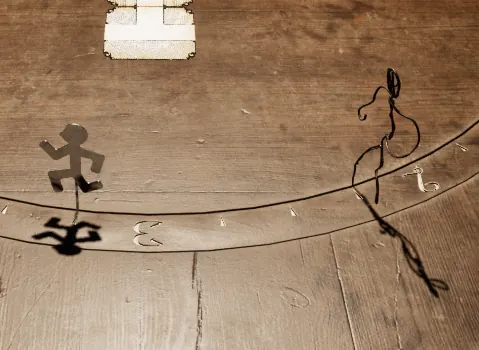
The Visitor is chasing the group’s shared piece rather than any individual player. Playing Progress Cards is what carries you toward midnight and puts distance between you and him at the same time. He does not move forward after an Event, whether the Event went well or badly.
If the Visitor catches up
If the Visitor reaches the group’s piece, you get one final turn to move away from him. That turn plays out normally. You start it, take a card, and you have to actually move the piece before the turn is over. If the turn ends without the piece moving, the run is lost.
Think twice about taking the unknown card from the Draw Slot on that turn. Some cards end your turn on the spot, before you get a chance to play a Progress Card out of your hand.
Event Cards
An Event Card is not something you hold and play when it suits you. If the card you take at the start of the turn turns out to be an Event Card, the Event begins the moment you accept it, and it usually ends the rest of that turn.
Events vary a lot, so read the card closely and watch for extra prompts that appear on screen once it has started. Generally you are given an objective to complete while something dangerous is in play. Normal turn order is paused until the Event is done. Depending on which one you get, you may be exploring, using objects, finishing a task, hiding, or keeping away from a threat.
If a player is eliminated during an Event
Being eliminated does not end the game for everyone else. The eliminated player is sent to The Cellar and can spectate from there while the rest of the group carries on.
The clock jumps forward by one hour for every player eliminated during that Event.
That is not the same as losing to the Visitor. Failing to move away from him ends the entire run, instead of sending one player down to the Cellar.
Midnight and the final escape
Reaching midnight starts the final stage of the game, and it is not automatically a loss.
Ideally you have identified all three clues by the time you get there. The final stage still runs if you have not, which means you may have to make your best deduction from the clues you did manage to uncover.
When midnight arrives, follow the instructions the game gives you and make your way to the room you believe is the exit. In multiplayer each player chooses for themselves, and you do not all have to pick the same room. Anyone who picks the correct room escapes and anyone who picks a wrong one does not, so a group can finish with some players out and some left behind.
More the cabin game guides
-
walkthroughThe Cabin Game: 10 Event Walkthroughs
How to complete 10 Events in The Cabin Game, including Cutting Corners, The Attic, Clovers of Doom, The Knight, Musical Rooms and The Basement.
Published September 2, 2026